
The wholesale inflation rose for the third consecutive month in May at 2.61 per cent on account of rise in prices of food articles, especially vegetables, and manufactured items. The wholesale price index (WPI) based inflation was 1.26 per cent in the previous month. It was (-) 3.61 per cent in May 2023. "Positive rate of inflation in May, 2024 is primarily due to increase in prices of food articles, manufacture of food products, crude petroleum & natural gas, mineral oils, other manufacturing etc," the ministry of commerce & industry said in a statement on Friday.

The rupee has depreciated by 0.6 per cent so far in the current financial year.

Retail inflation in August inched up to 3.65 per cent, though vegetables and pulses witnessed price rise in double digits, according to official data released on Thursday. The retail inflation based on the Consumer Price Index (CPI), however, remained below the Reserve Bank's median target of 4 per cent for the second month in a row. It was at a five-year low of 3.6 per cent in July.

Equity benchmark indices Sensex and Nifty hit their fresh record levels on Thursday after lower inflation numbers raised hopes of an interest rate cut by the RBI. Besides, heavy buying in capital goods, consumer durable and industrial stocks also helped the indices, traders said. Retail inflation continued its downward slide to reach a one-year low of 4.75 per cent in May due to a marginal decline of prices in the food basket and remained within the Reserve Bank's comfort zone of below 6 per cent, according to government data released on Wednesday.

Union Finance Minister Nirmala Sitharaman on Monday said people are finding current interest rates "very stressful" and urged banks to make them affordable. Speaking at an event organised by State Bank of India, the finance minister said that at present, India requires industry to ramp up and invest in new facilities, and added that lowering lending rates can help achieve the "Viksit Bharat" aspiration.

At a time when crude oil and natural gas prices are sky-high, public sector behemoth ONGC's haphazard planning and mismanagement in developing showpiece deep-sea KG-D5 block is costing the nation over Rs 18,000 crores due to the delayed output of oil and gas, government officials said. ONGC was originally to start gas production from the Cluster-II fields in block KG-DWN-98/2 (KG-D5) in June 2019 and the first oil was to flow in March 2020. But these targets were quietly shifted to end-2021 because of deferments in awarding the fragmented work packages of the project, two officials with direct knowledge of the matter said on condition of anonymity.

OPEC's move to cut output has pushed up oil prices. From here it could go either way: oil could reach $100/barrel or an analysis of demand and supply might follow, say Abheek Barua & Bidisha Ganguly.

Among the 30 Sensex companies, Axis Bank, ICICI Bank, HDFC Bank, Tech Mahindra, Larsen & Toubro, Bajaj Finserv, State Bank of India, Reliance Industries and Infosys were the biggest gainers. Power Grid, Asian Paints, Tata Steel, Nestle, Maruti and JSW Steel were among the laggards.

Wholesale inflation fell to a 4-month low of 1.31 per cent in August due to a decline in prices of vegetables and fuel, even though onion and potato prices spiked, according to official data released on Tuesday. Wholesale price index-based inflation fell for the second straight month in August after it hit a high of 3.43 per cent in May. Inflation in July was 2.04 per cent. In August last year, WPI inflation was (-) 0.46 per cent.
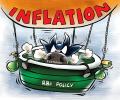
The Reserve Bank of India on Friday retained its projection for retail inflation at 4.5 per cent for the current fiscal assuming a normal monsoon, while emphasising that uncertainties related to food price outlook warrant a close monitoring. Consumer Price Index (CPI)-based retail inflation has been projected at 4.5 per cent with quarter-wise projections at 4.9 per cent in Q1 (April-June), 3.8 per cent in Q2, 4.6 per cent in Q3, and 4.5 per cent in Q4.

If growth reverts to the pre-Covid level, a lot of people may have to temper their rosy optimism, points out Debashis Basu.

Domestic macroeconomic data announcements, global trends and trading activity of foreign investors would guide market sentiments this week, analysts said. After a record rally, markets may face volatile trends this week amid elevated valuations and investors would also keep a track of global oil benchmark Brent crude and rupee-dollar movement for further cues. "Potential volatility in the stock market is anticipated this week. Elevated valuations remain a concern, with investors now focusing on monsoon progress and its impact on the rural economy.

Besides IOC, ONGC Videsh Ltd has also sought two discovered fields from the 16 fields that Iran is likely to put on auction shortly

A potential risk to the rupee's appreciation trajectory lies in the event of a delay in the Federal Reserve's rate cut cycle, particularly if core inflation in the US remains elevated.

The bias for the BSE benchmark index, technical charts suggest, is likely to remain bullish as long as the index holds above 75,600 levels for the rest of the year.

While India won't be immune to global spillovers, we need to create the macro preconditions for sustained growth. Policy agility, prudence, and resilience will be key, suggests Sonal Varma.

From the Sensex basket, Larsen & Toubro, Maruti, Reliance Industries, Nestle, Bharti Airtel, UltraTech Cement, Kotak Mahindra Bank and JSW Steel were among the major laggards. Bajaj Finance climbed nearly 1 per cent higher.

A massive drone strike on the world's largest crude-processing facility operated by Saudi Arabia's Aramco has driven oil prices to their highest level in nearly four months. The attack has knocked out over half of Saudi Arabia's production as it cut 5.7 million barrels per day or over 5 per cent of the world's supply.
Equity markets will take cues from global trends and trading activity of foreign investors, while in the latter part of the week the first quarter earnings from IT majors TCS and HCL Technologies would guide investor sentiments, analysts said. Markets may consolidate after the record rally last week, experts added. "On the domestic front, the Q1 earnings season begins this week. Key companies such as TCS and HCL Technologies will release their earnings on July 11 and 12, 2024, respectively.

Among the Sensex firms, Tech Mahindra, HCL Technologies, Wipro, Infosys, Bajaj Finance, Tata Consultancy Services, Bajaj Finserv and ICICI Bank were the major gainers. Power Grid, Nestle, Asian Paints and Hindustan Unilever were among the laggards.

The pricing and marketing freedom for exploitation would be capped by a ceiling price.

DGH director general V K Sibal objected to Hardy, which holds 10 per cent stake in RIL-operated D3 and D9 blocks, making 'an unwarranted, unethical and premature announcement that is bound to mislead' and influence share price. Sibal on May 29 wrote to Securities and Exchange Board of India chairman C B Bhave asking the market regulator to take up with its counterpart in London the unauthorised statement made by Hardy about its assessment of reserves in the two blocks.

Indian reserves stood at $343 billion at the end of March 2015.

The US Federal Reserve's interest rate decision, global market trends and trading activity of foreign investors are the major factors that would dictate terms in the equity markets in a holiday-shortened week ahead, analysts said. Equity markets will remain closed on Tuesday on account of Ganesh Chaturthi. From the global front, interest rate decisions from the Bank of England and Bank of Japan would also influence market trends.

'Invest only in stocks of those companies that deliver on earnings and there is earnings visibility too for the next few quarters.'

Retail inflation declined to a five-month low of 4.85 per cent in March mainly due to cooling food prices, inching towards the Reserve Bank's target of 4 per cent, according to official data released on Friday. The Consumer Price Index (CPI) based retail inflation was 5.09 per cent in February and 5.66 per cent in March 2023. Previously, CPI-based inflation was the lowest at 4.87 per cent in October 2023.

From the Sensex basket, Sun Pharma, Maruti, IndusInd Bank, Titan, ITC, Tata Motors, Larsen & Toubro and JSW Steel were the major gainers. On the other hand, Infosys, Wipro, HCL Technologies, Tata Consultancy Services, Tech Mahindra and Bajaj Finserv were among the laggards.
From the Sensex basket, NTPC, Power Grid, IndusInd Bank, Tata Steel, Tata Motors, JSW Steel, Tech Mahindra and Larsen & Toubro were the biggest gainers. Bharti Airtel, Maruti, ICICI Bank and Asian Paints were the laggards.

'As matters stand, Russia and Saudi Arabia, two of the world's biggest oil producers, are set for a hard landing as they didn't diversify their economies as much as they should have when the oil prices were booming.'

ndia will not get a better opponent than New Zealand, which is not a fancied side like its Trans-Tasman neighbour. But the two-time runners-up are as tough as nails.

A consortium of British Gas, Oil and Natural Gas Corporation and Reliance Industries, which controls the PMT fields off the west coast, is spending about Rs 2,500 crore (Rs 25 billion) for reviving the reserve in this fiscal, while new wells are being drilled at the Cairn-operated Ravva field (off the Andhra coast) for small-sized additional discoveries. The Tapti field has witnessed 'natural decline in the production profile' during the first quarter ended June 2009.
Wholesale inflation fell to a 3-month low of 2.04 per cent in July on decline in prices of food items especially vegetables, government data released on Wednesday showed. The decline in wholesale price index (WPI) based inflation in July came after it rose for four months in a row till June, when it was 3.36 per cent. It was (-) 1.23 per cent in July last year. In April wholesale inflation stood at 1.19 per cent.

India's exports to Iran have been falling over the last one year, amid decline in rupee reserves of the West Asian economy. Going ahead, the possibility of augmenting exports to Iran may not be easy for India, considering the geopolitical tensions - Russia-Ukraine and Israel-Hamas conflicts - and the West Asian country's support for Russia and Hamas, people aware of the matter said. Exports to Iran saw a downward spiral since November last year.

India's foreign exchange reserves surged $5.04 billion in the week ending March 28, its biggest weekly rise in four months, as the central bank started to buy dollars regularly in an effort to build up its defences against any potential global turmoil.

Indian family-run business houses have in recent years seen ugly public spats between owners over control. But metals-to-ports conglomerate Essar's Ruia family seems to be an exception. Three generations of the Ruia family - founder brother Shashi and Ravi Ruia, their children and grandchildren - continue to live under one roof and jointly run the business empire.
A higher-than-expected consumer price inflation (CPI) print for March in the US has dashed hopes of an interest rate cut by the US Federal Reserve (US Fed) in June. Analysts now expect the US central bank to start cutting rates in September, provided inflation remains in check and oil prices remain supportive. The markets, analysts believe, partially factored in this possibility.
Oil and Natural Gas Corporation has discovered new reserves of oil in Assam, Subir Raha, chairman and managing director of the company, said on Wednesday.

Cairn India, which had made four discoveries in the KG-DWN-98/2 block before selling 90 per cent out of its 100 per cent stake in the block to ONGC in 2005, has written to the oil regulator DGH saying the state-owned firm is grossly overstating the reserves in block, sources said.

Green Tomato Days are here. Make the most of them.

The benchmark Indian crude oil basket is now estimated to average $77.88 a barrel for FY19, compared to the government's earlier estimate of $65 a barrel for the year and $56.39 for FY18
